When building a food safety management system, one of the most important tasks is identifying where food safety hazards can occur and determining which steps are essential for controlling them.
A Critical Control Point (CCP) is a step in a food process where a food safety hazard can be prevented, eliminated, or reduced to an acceptable level. CCPs are a core part of a HACCP-based food safety system and help food businesses protect consumers, meet legal requirements, and prevent costly food safety incidents.
Whether you operate a restaurant group, care home kitchen, or central kitchen, understanding CCPs is essential for maintaining food safety standards.
Key points covered
A Critical Control Point (CCP) is a step where a food safety hazard can be controlled or eliminated.
CCPs are identified through hazard analysis as part of a HACCP plan.
Not every control measure is a CCP.
Common CCPs include cooking, chilling, cooling, and hot holding.
CCPs require monitoring, corrective actions, verification, and record keeping.
CCPs vary between businesses depending on products, processes, equipment, and risks.
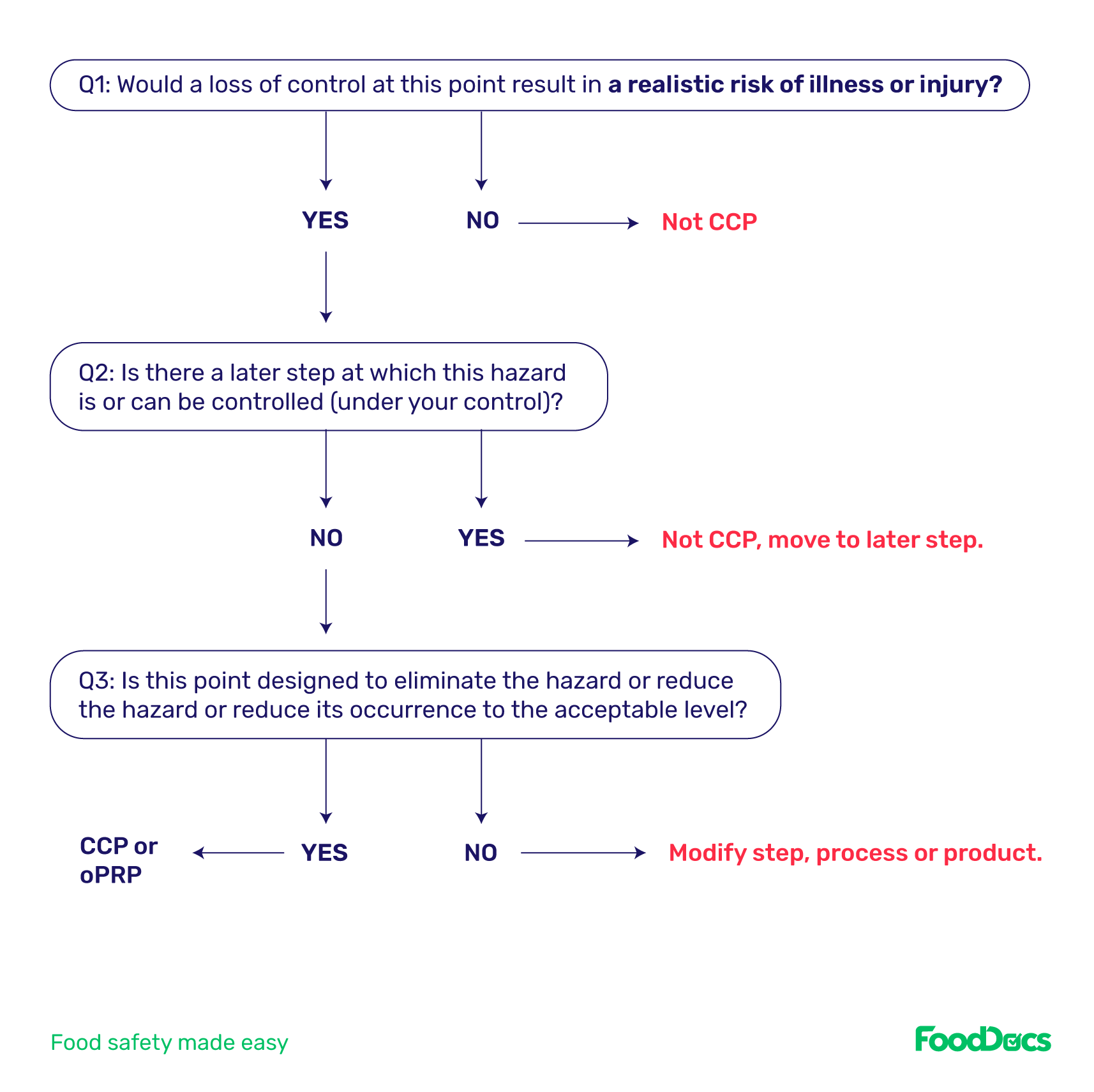
Decision trees are commonly used to determine whether a process step is a CCP.
Digital food safety software like FoodDocs,helps standardise CCP monitoring, reduce missed checks, and save food safety leaders time on supervision, record reviews, and audit preparation.
ToC is currently active
What is a critical control point?
A Critical Control Point (CCP) is a step in a food process where control can be applied to prevent, eliminate, or reduce a food safety hazard to an acceptable level.
In practical terms, a CCP is often the last opportunity to control a significant hazard before food reaches the customer. If the CCP fails and no further control step exists, unsafe food could be served.
CCPs are identified during a hazard analysis, which is a key stage of a HACCP system. During this process, businesses assess potential biological, chemical, physical, and allergen hazards and determine where control is essential.
Examples of CCPs may include:
Cooking food to a safe internal temperature
Rapid cooling of cooked food
Refrigerated storage of high-risk foods
Hot holding cooked food before service
Metal detection during manufacturing
Product formulation controls
Testing for specific toxins
Digital cooking logs help teams record cooking temperatures consistently while giving food safety leaders real-time visibility into compliance across their operations.
If you are new to HACCP, it may help to think of a CCP as a process step that cannot fail without creating a food safety risk.
For example, cooking raw chicken is a CCP because undercooking may allow harmful bacteria such as Salmonella to survive. If the required temperature is not reached, the food may not be safe to eat.
Businesses developing a HACCP plan should first understand the fundamentals of HACCP and hazard analysis before identifying CCPs. See our guides on what is HACCP, food safety hazards, and how to write a HACCP plan for a complete overview.
FoodDocs helps food businesses create a compliant HACCP plan in less than an hour, by automatically generating hazards, control measures, monitoring procedures, and food safety records, saving significant time compared to manual HACCP development.
What are control measures?
A control measure is any action, process, procedure, or activity used to prevent, eliminate, or reduce a food safety hazard.
Not all control measures are CCPs.
Examples of control measures include:
Handwashing procedures
Cleaning and sanitising
Pest control
Temperature monitoring
Supplier approval programmes
Staff training
Allergen controls
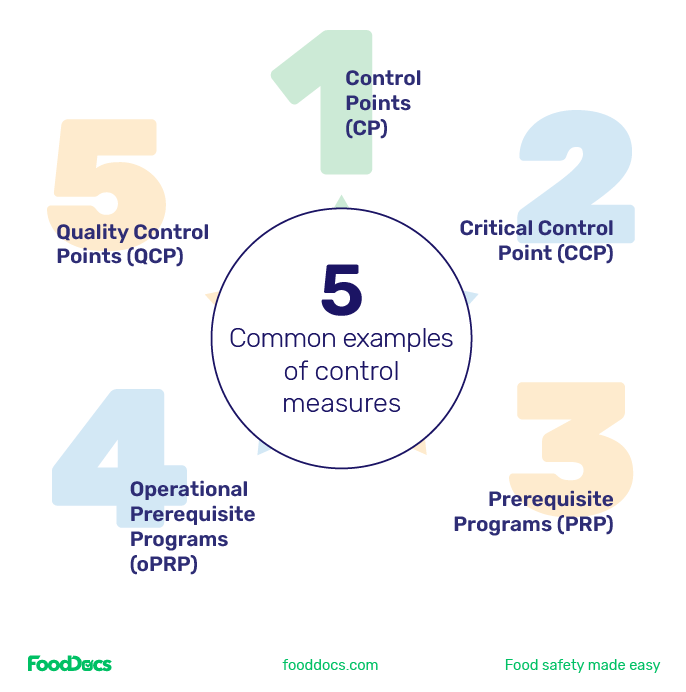
Control measures are generally classified as:
Control Points (CP)
Critical Control Points (CCP)
Prerequisite Programmes (PRPs)
Operational Prerequisite Programmes (oPRPs)
The correct classification depends on the severity of the hazard and where control occurs within the process.
What are the differences between CP, CCP, PRP, and oPRP?
In a HACCP food safety plan, other terminologies such as control point, prerequisite programs, and operational prerequisite programs may come up. To sort out any possible confusion surrounding these terms, let’s look into four main terms that you will come across when determining control measures and any critical control points for food safety.
Here's a comparison table that outlines the differences between Control Point (CP), Critical Control Point (CCP), Prerequisite Program (PRP), and Operational Prerequisite Program (oPRP):
Aspect
Control Point (CP)
Critical Control Point (CCP)
Prerequisite Program (PRP)
Operational Prerequisite Program (oPRP)
Definition
Any step where biological, chemical, and physical hazards can be controlled.
A step at which control can be applied and is essential to prevent or eliminate a food safety hazard or reduce it to an acceptable level.
Basic conditions and activities necessary to maintain a hygienic environment throughout the food chain.
Measures and activities used to control the likelihood of high levels of identified risks in the manufacturing process.
Role in Safety
May or may not be critical in eliminating hazards but contribute to their prevention and reduction.
Critical in eliminating food safety hazards or reducing them to an acceptable level.
Control low and moderate risk levels and maintain sanitary conditions to prevent food safety issues.
Specific to control identified high-risk hazards, based on in-depth hazard analysis.
Example
Prewashing potatoes to eliminate physical hazards before blanching.
Cooking food to safe internal temperatures to kill harmful bacteria.
Proper employee hygiene, handwashing, pest control, and basic sanitary design.
Specific measures like a particular cleaning process for a piece of equipment identified as a risk point.
System
HARPC (Hazard Analysis and Risk-Based Preventive Controls)
HACCP (Hazard Analysis and Critical Control Points)
HACCP (As the foundation)
Varies based on food regulatory standards (country or industry specific)
Focus
General control of hazards, not necessarily critical points.
Specific critical steps where hazards must be controlled to prevent safety risks.
General maintenance of hygiene and operational standards throughout the food chain.
Focused on controlling specific hazards identified as high risk in the process.
Application
Used throughout the process wherever control can be applied.
Applied only at critical steps where failure to control a hazard could result in unacceptable health risks.
General application to support HACCP, not focused on specific steps but essential for overall safety.
Applied at specific points or for specific equipment/processes where identified high risks must be controlled.
Control Point (CP)
A Control Point is any step where any biological, chemical and physical hazards can be controlled. This term is generally used for processes that may or may not be critical in eliminating hazards but contribute to their prevention and reduction. An example of a control point may be prewashing potatoes to eliminate any physical hazard before blanching, which serves a different purpose. Control Point is a concert used in the HARPC food safety system.
Critical Control Point (CCP)
One of the key HACCP principles, a CCP is the step at which control can be applied and is essential to prevent or eliminate a food safety hazard or reduce it to an acceptable level. If the potential hazard can be reduced or eliminated in another upcoming process, a control point is not critical. The clearest distinction between a CP and a CCP is that CCPs are the final step at which you can reduce hazardous contaminations to an acceptable level. The term CCP is based on the principles of HACCP.
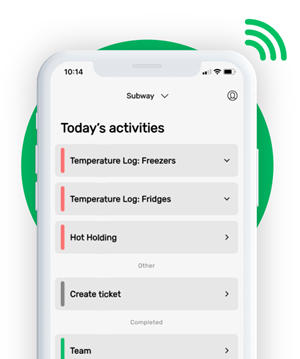
Digital food safety software helps teams monitor critical control points (CCPs) consistently. Automated reminders and notifications ensure food safety tasks are completed on time and nothing is missed.
Prerequisite program (PRP)
Necessary basic conditions and activities that are needed to maintain a hygienic environment throughout the food chain. You can control low and moderate risk levels by putting robust PRPs in place. Prerequisite programs are simple regulations such as proper employee hygiene, handwashing directions, pest control, and basic sanitary design principles.
These programs promote sanitary conditions to prevent food safety issues and maintain clean facilities. As the name suggests, prerequisite programs are needed to establish a HACCP food safety plan with a solid foundation and are considered their basic framework. Examples of prerequisite programs for HACCP can also include quality assurance procedures, labeling, standard operating procedures, and recipes.
Measures for the prevention of cross-contamination
Pest control
Traceability and recall
Staff hygiene
Cleaning and sanitizing
Operational prerequisite program (oPRP)
An oPRP controls significant hazards that do not require CCP management but still need specific operational controls.
Unlike PRPs, oPRPs are linked to identified hazards.
Examples may include:
Specific cleaning procedures
Controlled allergen segregation
Targeted sanitation activities
The distinction between CCPs and oPRPs often becomes clearer when conducting a detailed hazard analysis using the HACCP principles and a HACCP decision tree.
Why are critical control points important?
CCPs provide a structured way to control significant food safety hazards before they affect consumers.
Without CCPs, food businesses may struggle to demonstrate that hazards are effectively controlled.
CCPs help businesses:
Prevent foodborne illness
Protect consumers
Meet HACCP requirements
Improve food safety consistency
Support EHO inspections
Reduce food waste
Strengthen audit readiness
Protect business reputation
A well-designed HACCP system uses CCPs alongside prerequisite programmes and operational controls to create multiple layers of protection.
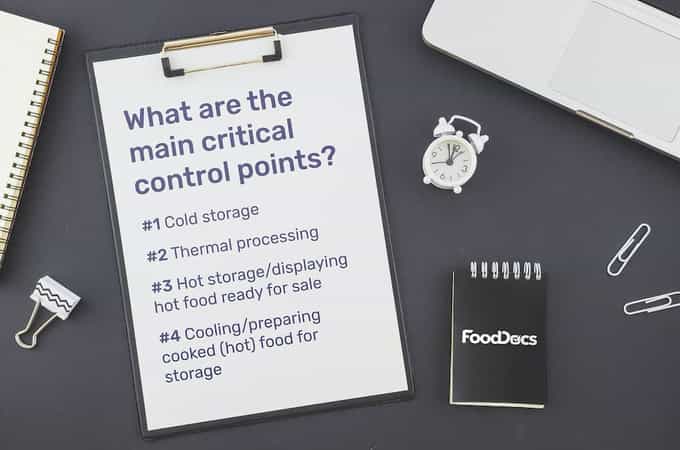
What are the most common critical control points?
CCPs vary between businesses, products, and processes. However, several CCPs are commonly found across hospitality, healthcare, catering, and food production operations.
1. Cold storage
Cold storage is often a CCP for high-risk foods such as raw meat, dairy products, cooked foods, and ready-to-eat items.
The purpose of refrigeration is to slow bacterial growth and maintain food quality.
Typical refrigerated storage temperatures in UK food businesses are 5°C or below, although many operators target 0°C to 3°C for additional safety.
Examples:
Raw meat storage
Cooked food storage
Chilled food transport
Ingredient storage
Failure to maintain refrigeration temperatures can allow harmful bacteria to multiply.
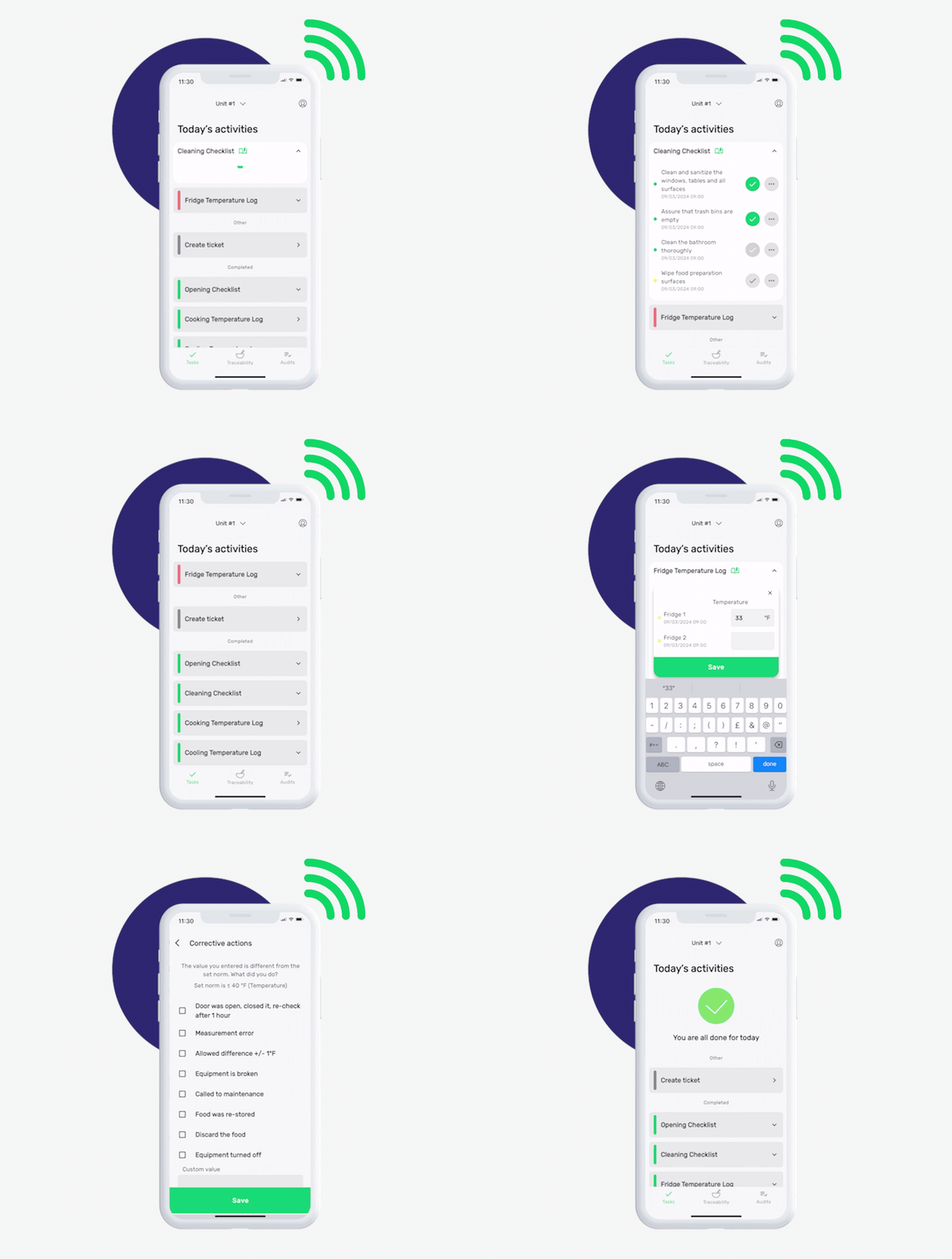
Digital monitoring checks include corrective actions. If a task is out of range, a prompt will guide your team on how to respond, ensuring food safety and saving time on training.
2. Thermal processing
Thermal processing becomes a CCP when heat is used to destroy pathogens.
Examples include:
Cooking
Pasteurisation
Canning
Rethermalisation
In hospitality settings, cooking is one of the most common CCPs.
For example:
Poultry should reach at least 75°C at the core
Reheated food should reach at least 75°C before service
Monitoring cooking temperatures and maintaining records helps verify that food is safe.
3. Hot holding
Hot holding is a common CCP in restaurants, hospitals, care homes, schools, and catering operations.
Cooked food that is being held before service should generally be maintained at 63°C or above under UK food safety guidance.
Keeping food above this temperature helps prevent bacterial growth.
Examples include:
Buffet service
Carvery stations
Care home meal service
School catering
Grab-and-go hot food counters
A digital hot-holding log helps ensure temperatures are recorded consistently and accurately, provides instant proof of compliance, and saves managers time on supervision, paperwork, and staff training.
4. Cooling cooked foods
Cooling is often a CCP because bacteria can multiply rapidly while food passes through the temperature danger zone.
Cooked food should be cooled as quickly as possible before refrigerated storage.
Common methods include:
Dividing food into smaller portions
Using shallow containers
Blast chilling
Ice baths
This CCP is particularly important in central kitchens, hospitals, care homes, and catering operations where large batches are prepared in advance.
A digital cooling loghelps staff consistently follow safe cooling procedures, records temperatures automatically with time-stamped evidence, and saves managers time on supervision, record keeping, and compliance checks.
Other examples of critical control points
Depending on the operation, additional CCPs may include:
Allergen cross-contact prevention
While allergen controls are often managed through PRPs or oPRPs, some businesses may identify specific allergen controls as CCPs where failure could directly affect consumer safety.
Metal detection
Food manufacturers often use metal detectors as CCPs to identify physical contamination before products leave the facility.
Toxin testing
Testing for contaminants such as aflatoxins may be a CCP in grain, nut, and cereal production.
Product formulation control
Incorrect ingredient levels can create food safety risks.
Examples include:
Insufficient preservatives
Incorrect acidity levels
Incorrect salt concentrations
How to identify CCPs
The most common method for identifying CCPs is through a HACCP hazard analysis supported by a decision tree.
The process typically involves:
Mapping the food process.
Identifying food safety hazards.
Evaluating the severity and likelihood of each hazard.
Determining available control measures.
Using a decision tree to determine whether a step is a CCP.
When identifying CCPs, consider:
Biological hazards
Chemical hazards
Physical hazards
Allergen hazards
A CCP should only be assigned when control at that step is essential and no later process can adequately manage the hazard.
Many businesses use a combination of hazard analysis, risk assessment, and HACCP decision trees to justify CCP decisions.
Monitoring and corrective actions for CCPs
Every CCP must have:
Critical limits
Monitoring procedures
Corrective actions
Verification activities
Record-keeping procedures
Digital monitoring checks include corrective actions. If a task is out of range, a prompt will guide your team on how to respond, ensuring food safety and saving time on training.
For example, a cooking CCP may include:
Element
Example
Critical limit
Core temperature ≥75°C
Monitoring
Probe thermometer check
Frequency
Every batch
Corrective action
Continue cooking or discard food
Verification
Review records and thermometer calibration
Each CCP should also have clearly defined critical limits that determine whether the process remains under control.
Digital monitoring of critical control points
Managing CCP records on paper can become difficult, particularly across multiple sites.
Digital food safety systems such as FoodDocs help teams:
Standardise CCP monitoring
Reduce missed checks
Record corrective actions
Maintain audit-ready records
Monitor compliance across multiple locations
Save time on supervision and record reviews
For hospitality groups, healthcare providers, and catering businesses, digital monitoring provides better visibility of food safety performance while reducing administrative workload.
Frequently asked questions
What is a critical control point in food safety?
A critical control point is a process step where a food safety hazard can be prevented, eliminated, or reduced to an acceptable level.
What are the most common critical control points?
The most common CCPs include cooking, chilling, cooling, hot holding, pasteurisation, and certain contamination detection processes.
What is the difference between a Control Point and a Critical Control Point?
A Control Point helps manage hazards, while a Critical Control Point is essential for preventing or eliminating a significant food safety hazard.
Who is responsible for monitoring CCPs?
Trained food handlers, supervisors, chefs, kitchen managers, quality teams, or designated food safety personnel may monitor CCPs depending on the operation.
What happens when a CCP is not met?
Corrective action must be taken immediately. This may involve continuing processing, isolating affected food, investigating the cause, and documenting the action taken.
Why is record keeping important for CCPs?
Records demonstrate that hazards are controlled, support HACCP compliance, assist with audits, and provide evidence during inspections or investigations.




.png?width=1650&height=1125&name=FSMS_hero%20(1).png)