Before a food business can implement an effective HACCP system, it must first establish the basic conditions that support safe food production. These foundational controls are known as prerequisite programs (PRPs).
A prerequisite program is a documented procedure that helps create and maintain a hygienic environment throughout food handling, preparation, storage, and service. PRPs address everyday food safety risks before they become hazards that require critical control points (CCPs) within a HACCP plan.
Without effective prerequisite programs, even the best HACCP plan will struggle to control food safety risks consistently.
ToC is currently active
Key points covered
Prerequisite programs (PRPs) form the foundation of every HACCP system.
PRPs control general food safety risks before they reach critical stages of production.
Common PRPs include cleaning, pest control, staff hygiene, allergen management, supplier approval, and traceability.
PRPs differ from operational prerequisite programs (OPRPs) and critical control points (CCPs).
Food businesses must establish PRPs before developing a HACCP plan.
Effective PRPs support compliance with UK food safety legislation and HACCP requirements.
PRPs are relevant to restaurants, hotels, care homes, hospitals, catering businesses, central kitchens, and food manufacturers.
Digital food safety systems like FoodDocs, can help standardise PRP implementation, monitoring, and documentation.
What is a prerequisite program?
A prerequisite program (PRP) is a documented set of procedures and conditions that creates a safe environment for food production, preparation, storage, and service.
PRPs control general food safety risks that exist across the entire operation rather than focusing on a specific process step. They establish the basic hygiene and operational standards that allow a HACCP system to function effectively.
Examples include:
Personal hygiene procedures
Cleaning and sanitation programmes
Pest control
Waste management
Equipment maintenance
Supplier approval
Allergen management
Staff training
Traceability procedures
In practical terms, PRPs help prevent hazards before they need to be managed through a critical control point.
What are the prerequisites in food hygiene?
Food hygiene depends on having the right systems, facilities, equipment, and staff practices in place to prevent contamination.
Several key prerequisites support good food hygiene in food businesses.
Food hygiene knowledge and staff training
Food handlers must understand how contamination occurs and what actions prevent it.
Training should cover:
Personal hygiene
Cross-contamination prevention
Cleaning procedures
Temperature control
Allergen awareness
Safe food handling practices
In the UK, food handlers are not legally required to hold a food hygiene certificate, but food business operators must ensure staff receive adequate training appropriate to their role.
Effective process controls
Food safety relies on daily operational controls that reduce risks throughout production and service.
Examples include:
Cooking food to safe temperatures
Correct chilled storage
Approved supplier procedures
Equipment maintenance
Stock rotation systems
Temperature monitoring
These controls help prevent biological, physical, and chemical contamination.
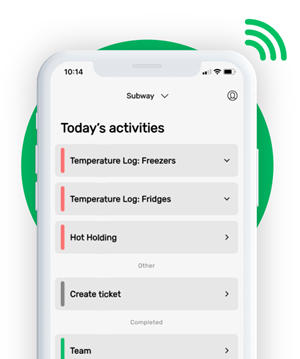
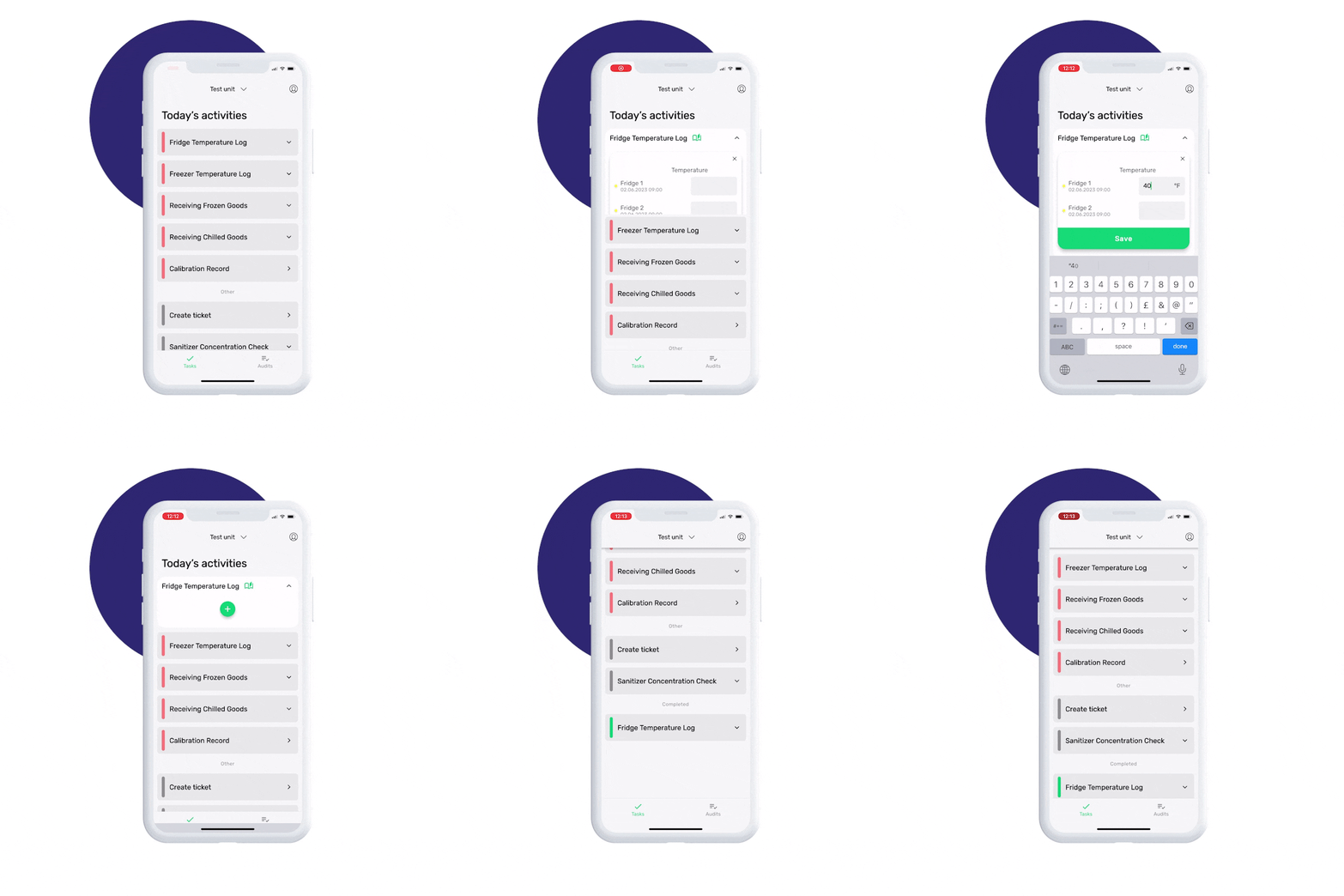
Digital monitoring helps teams complete food safety checks consistently and on time, while giving managers real-time visibility into compliance across all locations.
Hygienic facility design
The design and layout of food premises directly affect food safety.
Food businesses should ensure:
Surfaces are easy to clean
Production areas are appropriately zoned
Lighting is adequate
Ventilation prevents contamination
Pest entry points are controlled
Handwashing facilities are accessible
A well-designed facility makes it easier to maintain hygienic conditions every day.
Cleaning equipment and sanitation resources
Food handlers need appropriate tools to maintain hygiene standards.
Examples include:
Dedicated handwashing stations
Cleaning chemicals
Colour-coded cleaning equipment
Sanitising products
Cleaning schedules and records
Without suitable cleaning resources, contamination risks increase significantly.
Food safety management systems
A food safety management system brings together procedures that help identify, control, monitor, and verify food safety risks.
For most food businesses, this includes implementing a HACCP-based system. Understanding what HACCP is and how it applies to your operation is an essential step before developing more advanced food safety controls.
What are prerequisite programs for a HACCP program?
Prerequisite programs are the foundation upon which a HACCP plan is built.
Before conducting hazard analysis or identifying critical control points, a food business must ensure that basic food safety controls are already functioning effectively.
Without PRPs, HACCP teams often find themselves trying to manage routine hygiene failures through CCPs, making the system unnecessarily complex and difficult to maintain.
Examples include:
A pest control programme reducing contamination risks before production begins
Staff hygiene procedures preventing cross-contamination during food handling
Supplier approval procedures reducing risks associated with incoming materials
When PRPs are effective, the HACCP plan can focus on controlling significant hazards that remain after these foundational controls have been applied.
Businesses developing a HACCP system should also understand how to write a HACCP plan and how prerequisite programs support each stage of the process.
Prerequisite Program vs HACCP Plan
A HACCP plan and prerequisite programs work together, but they serve different purposes.
Prerequisite Programs (PRPs)
HACCP Plan
Control general food safety risks
Controls specific significant hazards
Apply across the whole operation
Apply to specific process steps
Focus on hygiene and operational conditions
Focus on hazard prevention and control
Usually monitored through procedures and checklists
Monitored through critical limits and records
Required before HACCP implementation
Built on top of PRPs
PRPs create the conditions that allow HACCP controls to work effectively.
HACCP prerequisite programs vs operational prerequisite programs (OPRPs)
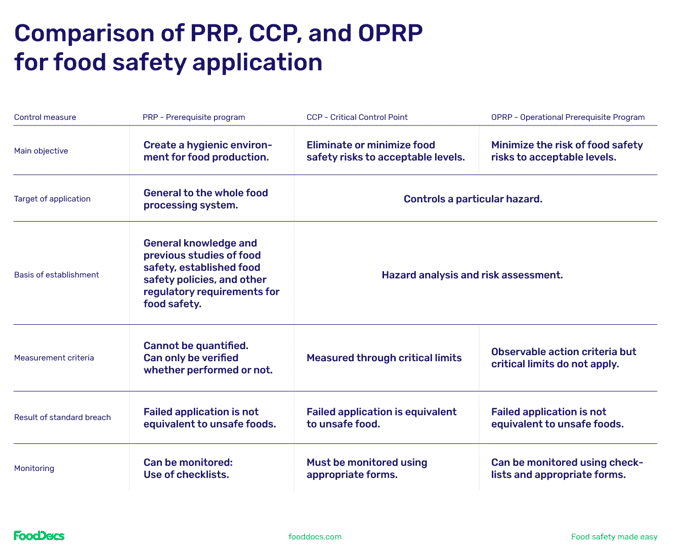
Operational prerequisite programs (OPRPs) sit between PRPs and CCPs.
An OPRP controls a significant food safety hazard but does not require the same level of monitoring or critical limits as a CCP.
Examples may include:
Metal detection
Sieve checks
Foreign body inspection systems
Certain allergen controls
Unlike PRPs, OPRPs are directly linked to identified food safety hazards.
Unlike CCPs, they do not always require scientifically validated critical limits.
Understanding this distinction helps HACCP teams apply controls appropriately and avoid overcomplicating their food safety management system.
HACCP prerequisite programs vs critical control points (CCPs)
A critical control point is a step where control is essential to prevent, eliminate, or reduce a significant hazard to an acceptable level.
Examples include:
Cooking
Chilling
Reheating
Pasteurisation
Each CCP requires:
Critical limits
Monitoring procedures
Corrective actions
Verification activities
Documentation
In contrast, PRPs establish the general conditions that support safe operations.
Who needs prerequisite programs?
Every food business requires prerequisite programs.
PRPs are relevant for:
Restaurant groups
Hotels
Catering companies
Food-to-go businesses
Care homes
Hospitals
School kitchens
Universities
Central production kitchens
Grocery foodservice operations
Food manufacturers
Regardless of size or sector, all food businesses must establish controls that support food hygiene and food safety.
For multi-site operators, standardised PRPs help ensure consistency across locations and simplify internal audits and EHO inspections.
Digital food safety software helps standardise prerequisite programmes (PRPs) across locations by ensuring every site follows the same procedures, monitoring requirements, and food safety standards. This improves consistency, reduces compliance gaps, and makes it easier to maintain company-wide food safety performance.
Examples of prerequisite programs for HACCP
Most food businesses use a combination of prerequisite programs to manage everyday food safety risks.
Common examples include:
Good Manufacturing Practices (GMPs)
Good Manufacturing Practices establish the basic operating conditions needed to produce safe food.
They typically cover:
Personal hygiene
Premises maintenance
Equipment standards
Cleaning procedures
Staff conduct
Sanitation Standard Operating Procedures (SSOPs)
SSOPs document how cleaning and sanitation activities must be completed.
These procedures help ensure food contact surfaces remain hygienic and suitable for food production.
Digital food safety software helpsensure SOPs are followed consistently by providing clear instructions within each task, guiding staff through the correct process, and giving managers visibility into task completion across all locations.
Pest control programme
Pest management procedures reduce the risk of contamination from rodents, insects, and birds.
They typically include:
Monitoring activities
Contractor inspections
Corrective actions
Site proofing measures
Waste management programme
Waste handling procedures help prevent contamination, pest attraction, and poor hygiene conditions.
Traceability and recall procedures
Traceability systems help food businesses identify affected products quickly during incidents or recalls.
Strong traceability supports both food safety compliance and customer confidence.
HACCP prerequisite program checklist
The exact PRPs required depend on your operation, but most food businesses should consider the following areas:
PRPs should be documented as standard operating procedures (SOPs).
Each procedure should include:
Procedure title
Purpose and scope
Responsible personnel
Applicable situations
Step-by-step instructions
Monitoring requirements
Verification activities
Corrective actions
Record-keeping requirements
Documented procedures improve consistency, simplify staff training, and provide evidence during audits and inspections.
Many HACCP teams also use hazard analysis findings to determine whether additional prerequisite procedures are required to address specific food safety hazards identified within their operation.
How FoodDocs helps create prerequisite programs
Creating and maintaining prerequisite programs manually can be time-consuming, particularly for businesses operating across multiple locations.
FoodDocs helps food businesses generate HACCP documentation and prerequisite programs significantly faster by automatically building procedures based on your operation.
The system can generate documented PRPs covering:
Food handling practices
Cleaning and sanitation
Equipment maintenance
Waste management
Pest control
Water safety
Allergen management
Staff hygiene and training
Supplier management
Temperature control
Traceability and recalls
Customer complaints
In addition to prerequisite procedures, FoodDocs helps businesses build a complete HACCP system that includes hazard analysis, monitoring procedures, critical limits, corrective actions, verification activities, and record-keeping requirements.
For multi-site hospitality groups, healthcare providers, catering operations, and food-to-go businesses, digital food safety software helps improve consistency, reduce paperwork, and simplify compliance management.
Frequently asked questions
What are the prerequisites for HACCP?
Prerequisite programs are the foundational procedures that support food safety before a HACCP plan is implemented. Examples include cleaning and sanitation, personal hygiene, pest control, supplier approval, allergen management, maintenance, and staff training.
What are the 5 preliminary HACCP steps?
The five preliminary HACCP steps are:
Assemble the HACCP team
Describe the product
Identify the intended use
Construct a process flow diagram
Verify the flow diagram on-site
These steps are completed before applying the seven HACCP principles.
What are the 7 fundamentals of HACCP?
The seven HACCP principles are:
Conduct a hazard analysis
Determine critical control points (CCPs)
Establish critical limits
Establish monitoring procedures
Establish corrective actions
Establish verification procedures
Establish documentation and record-keeping
You can learn more about the HACCP principles and how they are applied in food businesses.
What are the 5 C's of food safety?
The 5 C's of food safety are:
Cleaning
Cooking
Chilling
Cross-contamination prevention
Corrective action and checking
Together, they help reduce the risk of foodborne illness and support safe food handling practices.

.png?width=1650&height=1125&name=FSMS_hero%20(1).png)